Publications

Published or Accepted

Deep Learning for Crime Forecasting: The Role of Mobility at Fine-grained Spatiotemporal Scales

Albors Zumel, A., Tizzoni, M. & Campedelli, G. M.

Journal of Quantitative Criminology, 2025

Abstract
DOI ↗
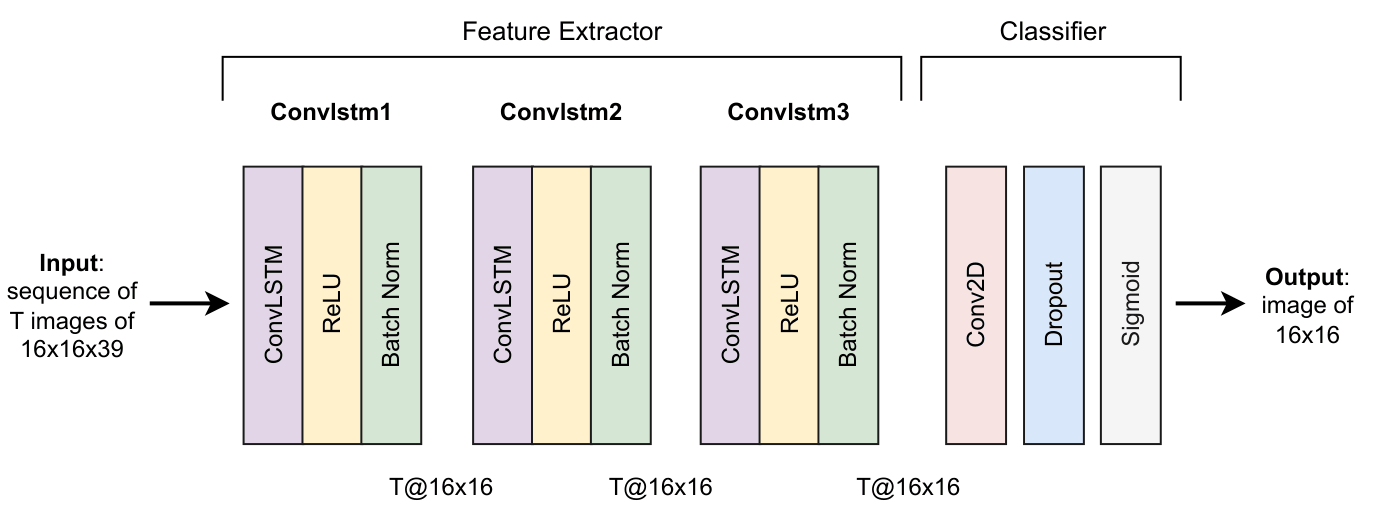
Model architecture: a ConvLSTM feature extractor of three
               ConvLSTM/ReLU/Batch-Norm blocks feeding a Conv2D/Dropout/Sigmoid
               classifier

Objectives. To develop a deep learning framework to evaluate if and how incorporating micro-level mobility features, alongside historical crime and sociodemographic data, enhances predictive performance in crime forecasting at fine-grained spatial and temporal resolutions.

Methods. We advance the literature on computational methods and crime forecasting by focusing on four U.S. cities (i.e., Baltimore, Chicago, Los Angeles, and Philadelphia). We employ crime incident data obtained from each city’s police department, combined with sociodemographic data from the American Community Survey and human mobility data from Advan, collected from 2019 to 2023. This data is aggregated into grids with equally sized cells of 0.077 sq. miles (0.2 sq. kms) and used to train our deep learning forecasting model, a Convolutional Long Short-Term Memory (ConvLSTM) network, which predicts crime occurrences 12 hours ahead using 14-day and 2-day input sequences. We also compare its performance against three baseline models: logistic regression, random forest, and standard LSTM.

Results. Incorporating mobility features improves predictive performance, especially when using shorter input sequences. Noteworthy, however, the best results are obtained when both mobility and sociodemographic features are used together, with our deep learning model achieving the highest recall, precision, and F1 score in all four cities, outperforming alternative methods. With this configuration, longer input sequences enhance predictions for violent crimes, while shorter sequences are more effective for property crimes.

Conclusions. These findings underscore the importance of integrating diverse data sources for spatiotemporal crime forecasting, mobility included. They also highlight the advantages (and limits) of deep learning when dealing with fine-grained spatial and temporal scales.

Computational approaches and the future of urban crime research

Campedelli, G. M., Jelveh, Z., Chalfin, A., Semenza, D., Piza, E., Albors Zumel, A., Lepri, B. & Sharkey, P.

Nature, 655, 315–326, 2026

Abstract
DOI ↗
Overview of non-traditional data sources and computational
               methods for urban crime research and their typical research
               goals

Urban environments have long been a central focus for crime researchers across diverse disciplines. Over the past few decades, this heterogeneous area of inquiry has experienced substantial methodological and empirical change, driven by the emergence of novel datasets and the increasing use of flexible computational methods. In this Review, we take stock of this evolution and examine the potential that these developments hold for advancing urban crime research, while also addressing the persistent challenges that continue to shape the field. Building on this overview, we emphasize the promise that computational methods offer for more rigorous causal inference beyond traditional prediction tasks. Finally, we outline three key directions for future research to ensure that new data and computational tools are used effectively: greater integration across disciplines, improved open science standards and a broader scope of inquiry beyond Western contexts. In doing so, we aim to support more rigorous research and inform the development of more effective policies for safer and more sustainable cities worldwide.

Under Review

Ambient Population and Crime: The Fragility of Causal Links in Urban Environments

Albors Zumel, A., Tizzoni, M., Hernández, W. & Campedelli, G. M.

Under review at Justice Quarterly

In Preparation

Unequal Suspicion: A Sequential Factorial Vignette Study of LLM Bias in Threat Detection

Albors Zumel, A., Tizzoni, M. & Campedelli, G. M.

In preparation